Molecular sieve crystallization plays a crucial role in determining framework structures and catalytic properties. However, the mechanisms underlying the crystallization of aluminophosphate (AlPO4-n) and silicoaluminophosphate (SAPO-n) molecular sieves under acidic conditions remain poorly understood, particularly the dynamic interactions between inorganic precursors and organic structure-directing agents (OSDAs).
Recently, a research team led by Prof. HOU Guangjin and Assoc. Prof. LIANG Lixin from the Dalian Institute of Chemical Physics (DICP) of the Chinese Academy of Sciences (CAS), in collaboration with Prof. DAI Weili from Nankai University, has revealed a proton-mediated crystallization mechanism using advanced operando solid-state magic angle spinning (MAS) nuclear magnetic resonance (NMR) spectroscopy.
The study was published in the Journal of the American Chemical Society.
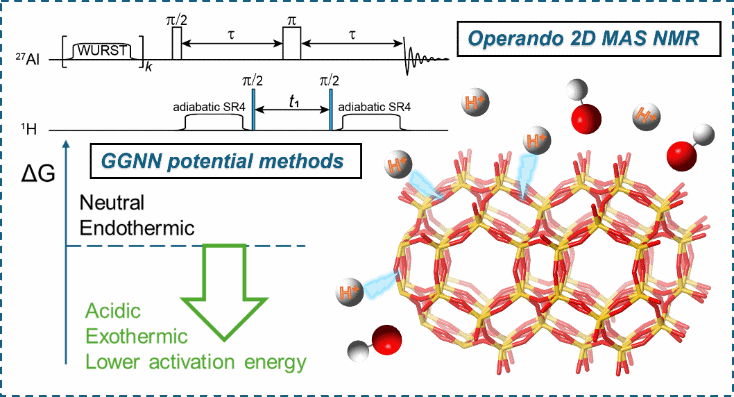
Proton-mediated host–guest interactions during molecular sieve crystallization revealed by ultrafast operando 2D solid-state NMR and GGNN potetial methods. (Image by WU Daoning)
The researchers developed an ultrafast two-dimensional (2D) 1H-27Al heteronuclear multiple-quantum coherence (HMQC) NMR technique based on an innovative adiabatic SR4 dipolar-recoupling pulse sequence. By introducing tanh/tan adiabatic inversion pulses, the method improved recoupling efficiency, enabling high-quality 2D correlation spectra to be acquired in 30 seconds.
Combined with theoretical simulations, the technique revealed a proton-mediated, dual-channel gating mechanism in which hydroxyl-driven hydrolysis and OSDA-mediated templating alternately regulate precursor reorganization and nucleation. The researchers further found that protonation accelerates P-O-Al condensation by lowering the activation energy and enhancing the thermodynamic driving force for framework formation.
The synergistic effects of proton-promoted nucleation and facet-selective stabilization also enabled the formation of nanosheet- and nanorod-like molecular sieves across different framework topologies.
"Our study provides new insights into the role of acidity in molecular sieve crystallization and establishes an advanced NMR approach for investigating crystallization mechanisms and guiding the rational synthesis of porous materials," said Prof. HOU.