Hydrogen production from seawater via water electrolysis using renewable energy is considered a desirable and sustainable pathway for large-scale green hydrogen production. However, direct seawater electrolysis is challenged by electrode side reactions and corrosion arising from the complex composition of seawater. Desalinating seawater before electrolysis can avoid these issues, but requires additional equipment and an energy input.
Moreover, conventional water electrolysis has relatively low electricity-to-hydrogen efficiency, with much of the remaining energy ultimately dissipated as low-grade waste heat. Developing an efficient and robust process that can simultaneously address these challenges is therefore important for the large-scale production of hydrogen from seawater.
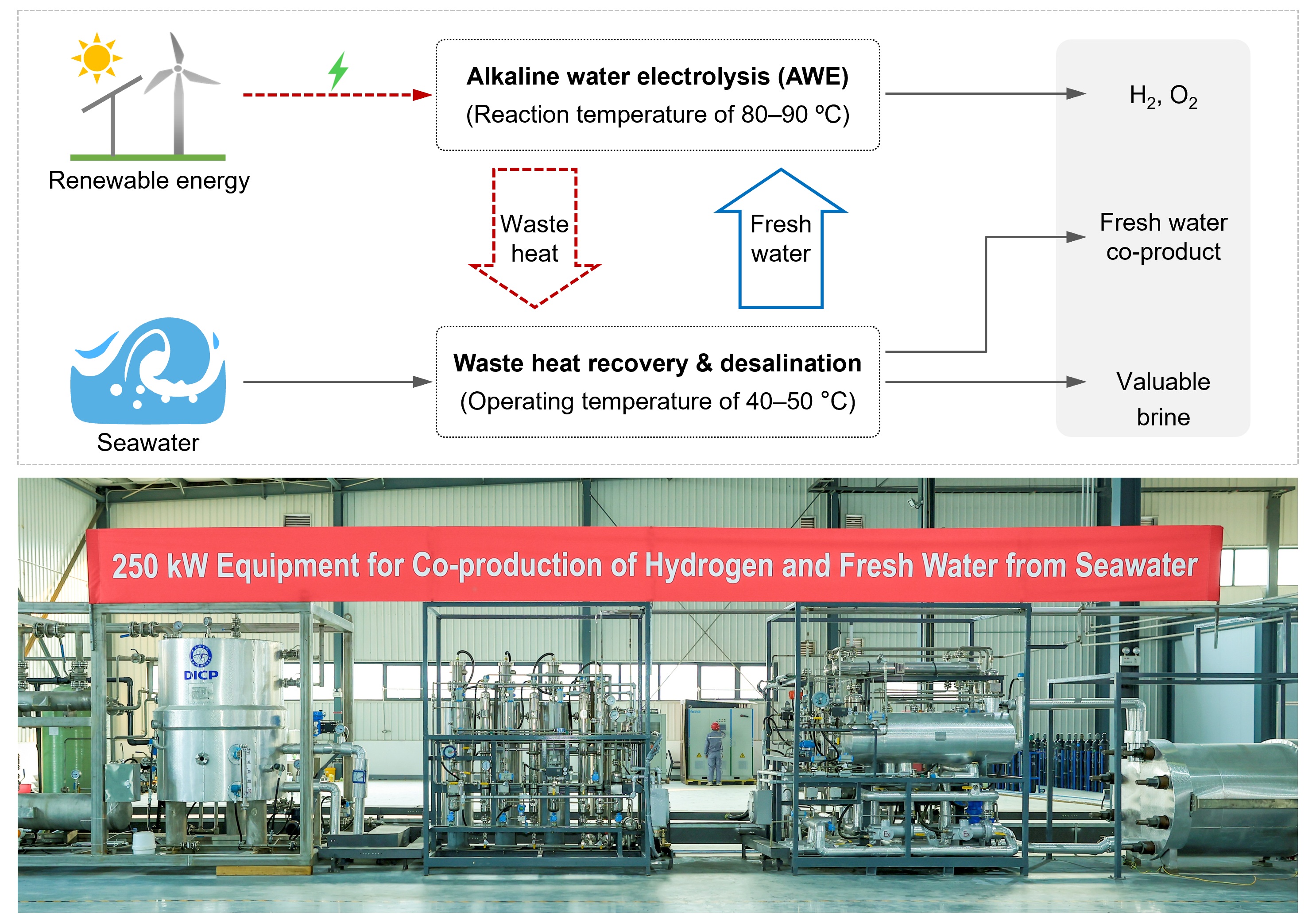
A 250 kW system and its process for co-production of hydrogen and fresh water from seawater (Image by JIANG Shang)
In a study published in Nature Energy, a team led by Prof. DENG Dehui and Associate Prof. LIU Yanting from the Dalian Institute of Chemical Physics (DICP) of the Chinese Academy of Sciences (CAS) proposed a"seawater to hydrogen and fresh water (STHW)" route that couples alkaline water electrolysis (AWE) with low-temperature vacuum distillation desalination.
The STHW process utilizes waste heat generated during AWE to drive low-temperature seawater desalination, producing fresh water for both electrolysis and external use. The resulting concentrated brine can also be utilized for resource recovery, including salt, uranium, and bromine.
The team built a 20 kW industrial pilot STHW system that achieved a hydrogen productivity of 3.8 Nm3 h-1 and operated stably for 100 days while co-producing 1.2 kg h-1 of fresh water. When scaled up to 250 kW, the system achieved a hydrogen productivity of 48 Nm3 h-1 with a purity of 99.9999%, together with fresh-water production of 31.6 kg h-1. The system also improved electrical efficiency by 14.4% compared with conventional alkaline electrolysis using fresh water alone.
"This study addresses two key challenges in seawater-based hydrogen production: the utilization of low-grade waste heat from water electrolysis and the stability and energy-efficiency limitations of direct seawater electrolysis," said Prof. DENG. "The work provides a potential pathway for more efficient hydrogen production from seawater while enabling the co-production of fresh water."
This work was highlighted in a News & Views article in Nature Energy. Prof. Jonathan G. Love from Central Queensland University described it as an important and interesting work, which overcomes community concerns about fresh water while reducing hydrogen production costs.