Partial oxidation of methane (POM) is an important potential industrial route for syngas production. Metallic nickel (Ni) nanoparticles have long been regarded as the catalytic active centers for POM. However, metallic Ni detected after reaction may simply result from the reduction of nickel oxide by syngas under high-temperature conditions, rather than represent the intrinsic active species.
Under high-temperature redox conditions, Ni species can undergo dynamic changes in valence state and structural reconstruction. However, these evolutionary processes have remained poorly understood, limiting our understanding of the true active site structure responsible for POM.
In a recent study published in Nature Catalysis, researchers revealed that active motifs can be generated in situ through the reconstruction of NiO surface during POM. These findings identify the atomic-scale origin of catalytic activity and demonstrate the importance of capturing dynamic structural evolution under realistic operating conditions.
The research was led by Prof. ZHANG Tao, Prof. WANG Aiqin, and Prof. LIU Xiaoyan from the Dalian Institute of Chemical Physics (DICP) of the Chinese Academy of Sciences (CAS), together with Prof. LIU Wei from DICP, Prof. YANG Tao from Xi’an Jiaotong University, and Prof. Graham J. Hutchings from Cardiff University,
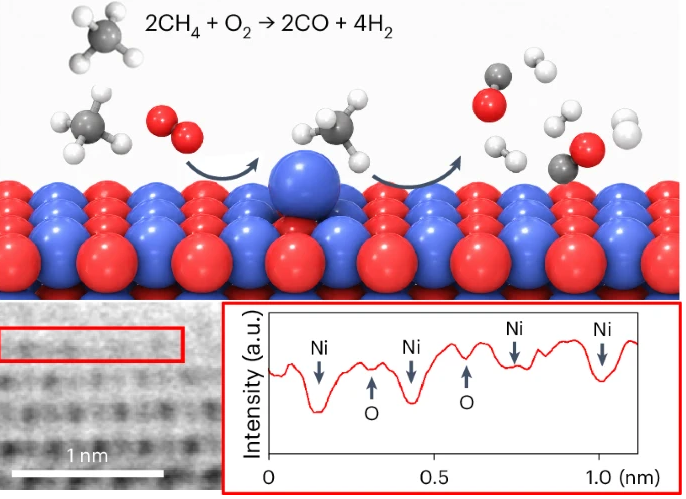
The model and image of the in situ formed [Ni1O4Ni4] active structure (Image by TAN Yuanlong and LIU Xiaoyan)
The researchers prepared a low-loading Ni/Al2O3 catalyst containing 0.8 wt% Ni using a microemulsion method. The catalyst exhibited high POM activity, achieving 92% methane conversion, with CO and H2 selectivities of 87.0% and a stable H2/CO molar ratio of approximately 2.0. Notably, almost no metallic Ni species were detected in the post-reaction catalyst. Its overall performance was comparable to that of a high-loading 8.0 wt% Ni/Al2O3 catalyst prepared by impregnation and substantially higher than that of a low-loading 0.8 wt% counterpart prepared by the same method, which showed only methane combustion activity under identical conditions.
The researchers found that metallic Ni nanoparticles present at the initial stage of the reaction were rapidly oxidized to NiO phase under POM conditions. However, a pre-formed pure-phase NiO catalyst exhibited no POM activity and instead catalyzed only the complete oxidation of methane.
Further investigation captured the in situ reconstruction of a [Ni1O1Ni4] active structural unit on the NiO(100) surface. DFT calculations showed that this reconstructed motif facilitates C–H bond cleavage in methane, with an activation barrier of only 12.5 kcal·mol-1. This is substantially lower than the barriers on the intact NiO(100) surface (38.5 kcal·mol⁻¹) and metallic Ni(111) surface (15.7 kcal·mol-1), demonstrating the kinetic advantage of the reconstructed structure for methane activation. Together, experimental and theoretical results identify the reconstructed motif as the active center responsible for POM.
"Our study highlights the critical role of in situ characterization in identifying dynamic active structures under reaction conditions," said Prof. LIU. "Dynamic reconstruction enables low-loading catalysts to achieve high performance, offering new opportunities for the rational design of efficient catalysts while reducing reliance on high metal loadings."