Ammonia is irreplaceable for agricultural fertilizers and is emerging as a zero-carbon energy carriers. Yet the dominant industrial Haber-Bosch process operates under extreme conditions—temperaures above 400 °C and pressure exceeding 100 bar—consuming large amounts of fossil energy and releasing significant carbon emissions.
The fundamental limitation lies in the universal scaling relation of thermal catalysis: catalysts capable of activating inert N≡N bonds typically bind nitrogen intermediates too strongly for subsequent hydrogenation, whereas weak nitrogen adsorption impedes N2 activation
Recently, a research team led by Prof. CHEN Ping and Prof. GUO Jianping from the Dalian Institute of Chemical Physics of the Chinese Academy of Sciences, in collaboration with Prof. WU Anan from Xiamen University, revealed a wavelength-dependent photo-driven pathway for ammonia synthesis over lithium hydride (LiH), enabling the decoupling of two long-standing conflicting reaction steps in thermal catalysis.
This study was published in Journal of the American Chemical Society.
The researchers identified a two-stage, wavelength-separated catalytic mechanism. Ultraviolet (UV) light (300-400 nm) exclusively activates LiH to facilitate N2 dissociation and formation of nitrogen intermediates, while both UV and visible light activate Li2NH/LiNH2 species to lower hydrogenation barriers, promote NH3 release, and regenerate LiH.
Under 1 bar and 644 K, the combined UV-visible illumination yields an ammonia concentration of 0.25% at the reactor outlet, nearly twice the thermal equilibrium limit (0.13%). The corresponding ammonia production rate reaches 1,246 μmol g-1 h-1, significantly outperforming either UV- or visible-only irradiation.
Density functional theory (DFT) calculations confirm that wavelength-specific photoexcitation selectively reshapes reaction energy barriers, thereby breaking the restrictive scaling relations of thermal ammonia synthesis.
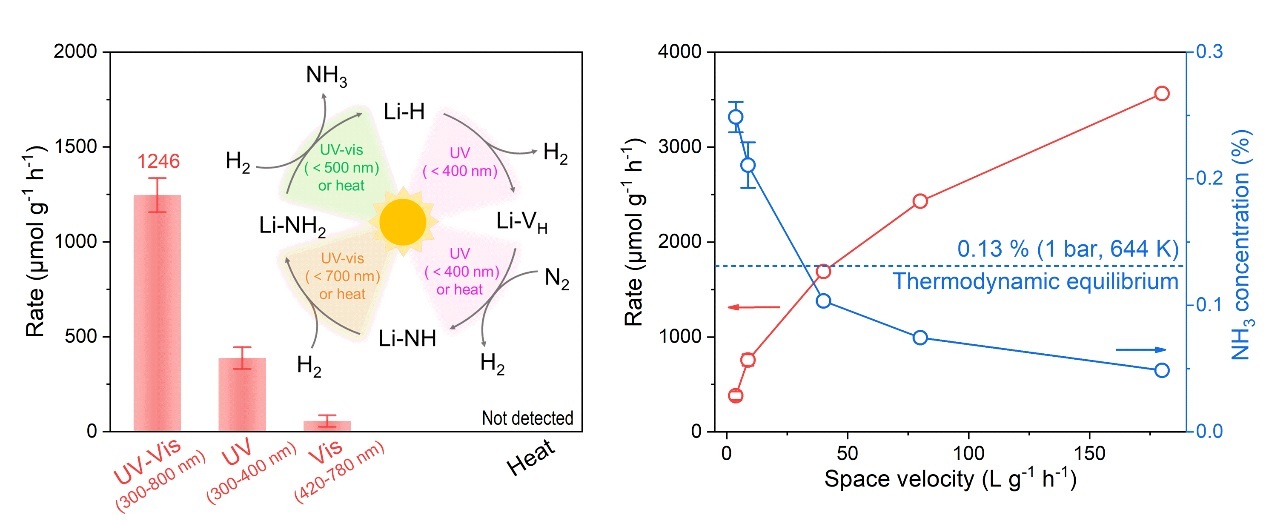
Schematics for the catalytic performance and mechanism of photo-driven ammonia synthesis process mediated by LiH(Image by GUAN Yeqin)
"Our study introduces a wavelength-dependent photoexcitation strategy that independently regulates different catalytic steps via tailored light wavelengths, offering a new guidance for mild, solar-driven nitrogen fixation and other energy-intensive catalytic reactions," said Prof. CHEN.