The gas-induced structural evolution of solid surfaces is a key issue in heterogeneous catalysis and surface science, as it strongly affects catalyst active states, stability, and reaction pathways. However, the direct role of gas-solid physical interactions in driving surface structural reconstruction has remained unclear.
Recently, a research group led by Prof. FU Qiang and Prof. MU Rentao from the Dalian Institute of Chemical Physics (DICP) of the Chinese Academy of Sciences (CAS), in collaboration with Prof. GU Xiangkui from Wuhan University and Prof. LI Weixue from the University of Science and Technology of China, uncovered the dynamic evolution of metal surface nanostructures induced by gas-solid interactions. They found that, at the atomic scale, van der Waals interactions between water molecules and surface Au atoms can drive the rapid migration, coalescence, and ripening of Au nanoislands on Au(111) in water vapor.
This study was published in the Journal of the American Chemical Society.
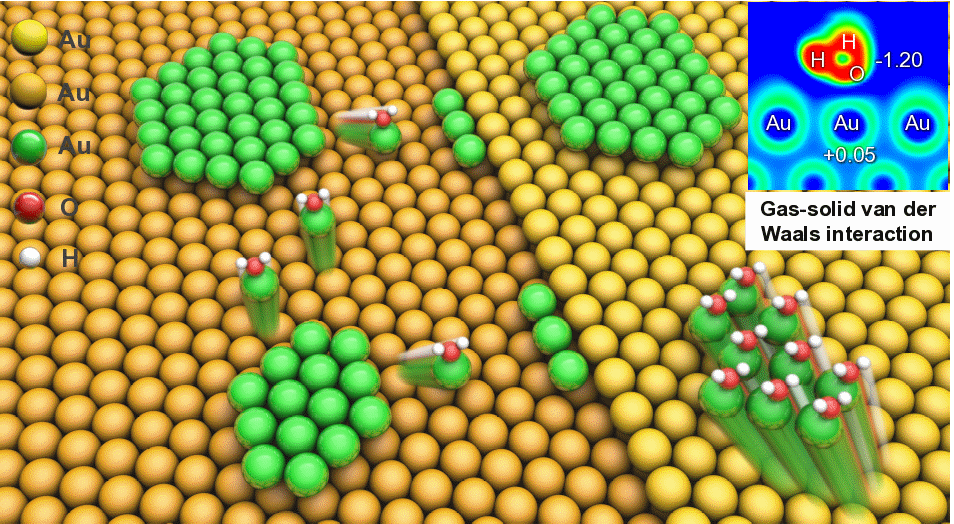
Schematic of van der Waals interactionsdrive the rapid migration, coalescence, and ripening of Au nanoislands on Au(111) in H2O atmosphere (Image by LIU Changping)
The researchers constructed monolayer Au nanoislands on an Au(111) surface and investigated their dynamic evolution under different gas atmospheres using high-pressure scanning tunneling microscopy, near-ambient-pressure X-ray photoelectron spectroscopy, and theoretical calculations.
They observed that these Au nanoislands underwent structural evolution — including particle migration, coalescence, and Ostwald ripening — in water vapor at room temperature.
"This work provides direct atomic-level evidence that gas-solid van der Waals interactions alone can reshape metal surface nanostructures under mild conditions," said Prof. FU. "It challenges the conventional understanding that gas-induced surface reconstruction is mainly governed by strong chemisorption or surface reactions."