Global production of polystyrene (PS) exceeds 20 million metric tons each year, representing roughly 6% of total plastic output. Yet less than 1% of PS is recycled, largely due to its chemical inertness and stable carbon-carbon and carbon-hydrogen bonds. Conventional recycling technologies are highly energy-intensive, while elemental sulfur (S8)—an abundant byproduct of petroleum refining—remains underutilized in high-value applications.
To address this challenge, a research team led by Prof. CHEN Qingan and Associate Prof. LIU Heng from the Dalian Institute of Chemical Physics (DICP), in collaboration with the team of Prof. HU Jianshe and Associate Prof. CHEN Zhangpei from Northeastern University, has developed a novel solar-driven co-upcycling strategy that enables the synergistic valorization of waste PS and elemental S8. The approach integrates clean solar energy with the high-value utilization of industrial byproducts.
The findings were recently published in Journal of the American Chemical Society.
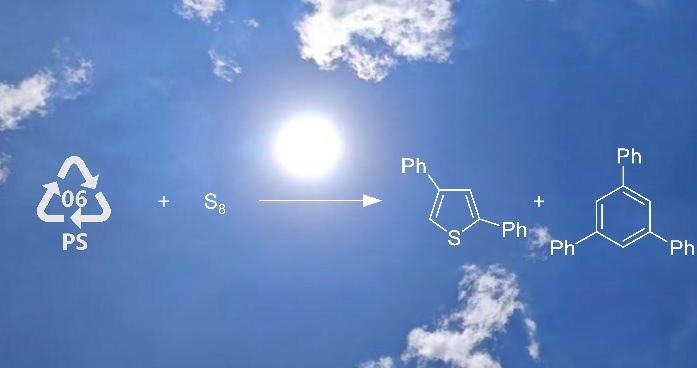
Solar-driven upcycling of polystyrene enabled by elemental sulfur (Image by LIU Yong and LIU Heng)
Taking advantage of elemental sulfur's dual function as both a photothermal agent and a reactant, concentrated sunlight rapidly heats the mixture of waste PS and S8 to temperatures above 320 °C in under two minutes. Under these conditions, the eight-membered ring of S8 molecules open to form reactive sulfur radicals, which initiate PS chain scission through hydrogen atom abstraction. The in-situ generation of degraded polystyrene and char further sustained a self-catalytic photothermal cycle, boosting overall conversion efficiency.
This solvent-free and noble metal-free process selectively converts waste PS into high-value chemicals, including 2,4-diphenylthiophene (34% yield) and 1,3,5-triphenylbenzene (16% yield, over $400 per kilogram).
Furthermore, the strategy is compatible with a wide range of post-consumer PS wastes—including disposable tableware, packaging materials, and lab consumables—as well as substituted PS derivatives, SAN, and ABS copolymers, demonstrating its suitability for mixed plastic waste streams.
The study provides a promising new route for mitigating plastic pollution and improving the comprehensive utilization of sulfur resources.
"This work convert two low-value feedstocks into high-value products while using solar energy to reduce dependence on fossil resources," said Prof. CHEN, the study's corresponding author. "It represents a promising step toward sustainable plastic recycling and a circular economy".