The wave nature of quantum particles underpins interference phenomena, which can influence chemical reactions by producing oscillatory patterns in product state or angular distributions. While such effects have been observed in several molecular systems, they are typically attributed to interference between spatially distinct paths. Whether interference can occur between a single reaction path, analogous to optical single-slit diffraction, has remained an open question.
In a recent study published in Nature Chemistry, a research team led by Prof. YUAN Kaijun from Dalian Institute of Chemical Physics (DICP) of the Chinese Academy of Sciences (CAS), in collaboration with Prof. XIE Daiqian's team from Nanjing University, has provided an answer by revealing quantum interference between direct and indirect reaction pathways in the photodissociation of partially deuterated water (HOD).
"Our experimental results revealed wavelength-dependent OD(X) product rotational state population distributions from photodissociation of HOD molecules at excitation wavelengths around121 nm," said Prof. YUAN.
Full-dimensional quantum calculations reproduced the experimental observations semi-quantitatively and revealed the underlying mechanism. The results showed that the experimentally observed phenomenon arises from dynamical interferences between direct and indirect dissociation pathsthat both traverse the same conical intersection (CI) seam at collinear H–OD geometries, analogous to "single-slit diffraction" in optics.
These observed dynamical signatures further demonstrated that interference can occur even within a single reaction path, suggesting a quantum mechanical route to control CI-mediated nonadiabatic dynamics.
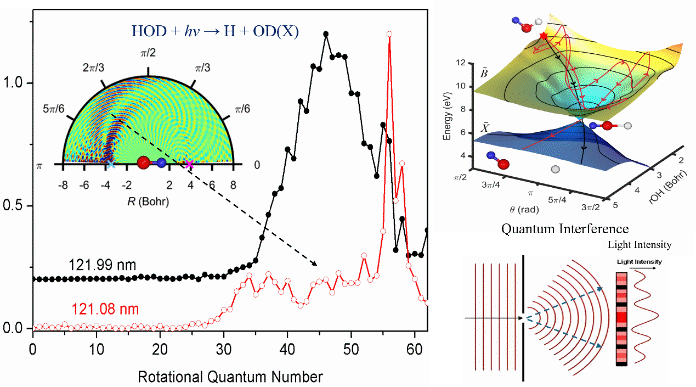
Scientists revealing quantum interference between direct and indirect reaction paths in the photodissociation of HOD (Image by YUAN Kaijun)