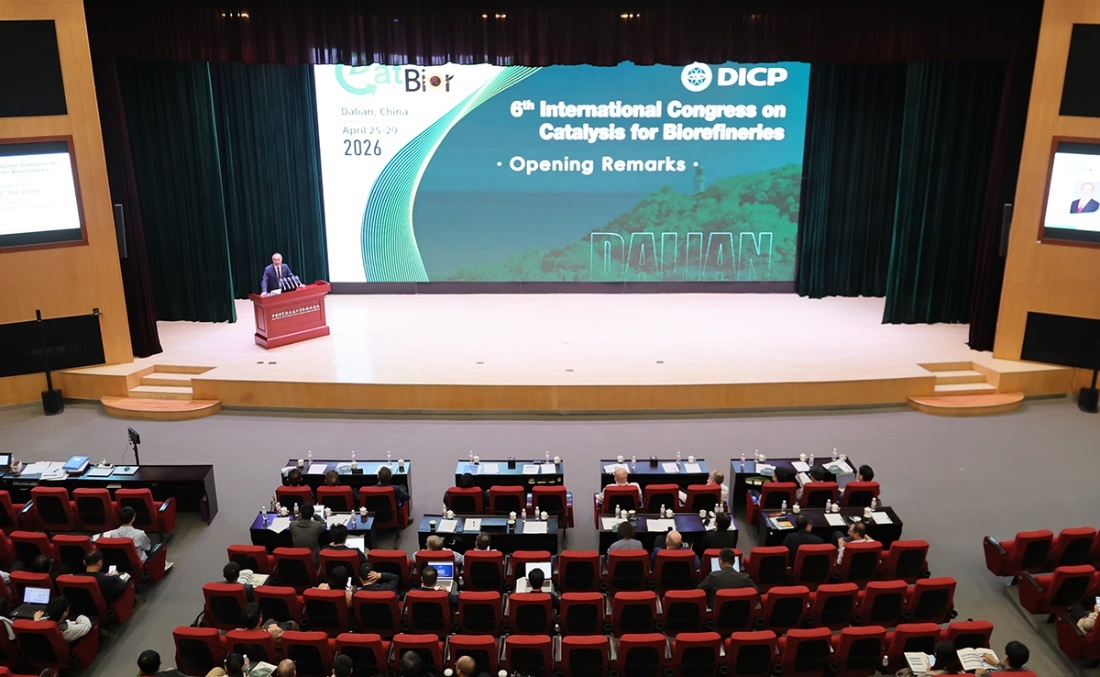
The 6th International Congress on Catalysis for Biorefineries (CatBior 2026) was held from April 25 to 28 at the Dalian Institute of Chemical Physics (DICP) of the Chinese Academy of Sciences, bringing together leading scientists and industry representatives to explore the future of sustainable biomass utilization under the theme "Biorefinery Beyond Boundaries".
In his opening remarks, conference chair Prof. ZHANG Tao from DICP emphasized a paradigm shift in catalysis—from maximizing conversion efficiency to optimizing atomic economy and minimizing carbon footprint. He highlighted biorefinery as a central pathway toward achieving carbon neutrality goals and encouraged young researchers to transcend disciplinary, national, and intellectual boundaries, calling for closer global collaboration within the catalysis community.
Conference secretary-general Prof. WANG Feng reviewed the development of the CatBior series since its inception in 2011. He said that CatBior 2026 marked the first in-person gathering following disruptions caused by the COVID-19 pandemic, and DICP's second time hosting the event since 2013, underscoring its renewed significance for international exchange.
The program featured four plenary lectures, nine keynote presentations, 39 invited talks, eight contributed oral presentations, 24 young investigator forum talks, and 47 poster presentations. Topics spanned catalytic conversion of lignocellulosic biomass, biobased polymers and materials, and upcycling of plastic waste. Participants engaged in in-depth discussions on catalytic mechanisms, process scale-up, carbon-neutral pathways, and industrial policy. Eight young researchers received Outstanding Poster Awards supported by the Royal Society of Chemistry.
During the conference, scholars from 12 countries jointly launched the Global Biorefinery Alliance (GBA), an initiative aimed at fostering global collaboration across academia, industry, and research institutions. The alliance seeks to promote resource sharing, capacity building, and technological innovation to accelerate the transition toward sustainable biorefinery systems.
At the closing ceremony, Prof. WANG noted that the field has progressed from asking whether biomass can be converted to focusing on how to achieve selective, sustainable conversion within closed carbon cycles—signaling the maturation of biorefinery research. He added that the GBA could become a lasting platform for cross-border and cross-disciplinary collaboration, while the creativity and initiative demonstrated by young scientists provide strong momentum for future advances.
Finally, Prof. WANG announced that the next CatBior conference will be hosted by the National University of Singapore, and encouraged participants to sustain collaboration and friendship in advancing biorefinery research for global sustainability.
The 6th CatBior 2026 was jointly organized by DICP and the Chinese Journal of Catalysis, and hosted by the Liaoning Key Laboratory of Biomass Conversion for Energy and Material and the Dalian Key Laboratory of Catalysis for Biorefineries. Supporting organizations included the Journal of Bioresources and Bioproducts and Green Carbon.
The conference attracted more than 200 participants from 14 countries, including leading experts such as Chunbao Xu (City University of Hong Kong), Licheng Sun (Westlake University), Bert F. Sels (KU Leuven), Chao-Jun Li (McGill University), Ning Yan (National University of Singapore), Joseph S. M. Samec (Stockholm University), Keiichi Tomishige (Tohoku University), and so on.