User-side energy storage is key for low-carbon energy use across residential, commercial, industrial, and transportation sectors, creating a growing demand for energy storage with high energy density and safety.
Tin-based anodes are promising candidates for high-energy-density flow batteries because they offer high theoretical specific capacity, high solubility, and dendrite-free during deposition, along with the potential for four-electron transfer. However, the conversion from Sn4+ to metallic Sn involves two consecutive electrochemical reactions, Sn4+/Sn2+ and Sn2+/Sn0. The Sn4+/Sn2+ conversion suffers from high reorganization energy, sluggish kinetics, and poor reversibility, limiting the utilization of the full four-electron capacity.
Recently, a research team led by Prof. LI Xianfeng from the Dalian Institute of Chemical Physics (DICP) of the Chinese Academy of Sciences (CAS), in collaboration with Prof. CHEN Shengli from Wuhan University has developed a coordination-structure modulation strategy to improve the kinetics and reversibility of tin redox reactions, enabling highly reversible four-electron transfer.
The study was published in Nature Chemistry on Oct. 9.
The researchers introduced iodide ions into a highly soluble tin tetrachloride (SnCl4) electrolyte to construct a coordination environment containing both SnCl62- and SnI62- species. The SnI62- species lower the reorganization energy associated with Sn4+/Sn2+ electron transfer, facilitating faster and more reversible reactions, while SnCl62- species maintain the high solubility of the tin salt in the electrolyte. This effect enables continuous four-electron transfer from Sn4+ to Sn0 through the intermediate Sn2+ state.
With this strategy, the potential difference between the Sn4+/Sn2+ redox peaks decreased from 978 mV in a chloride-dominated coordination environment to 97 mV in an iodide-containing environment. The researchers also observed a reduction in charge-transfer impedance, indicating improved electrochemical kinetics.
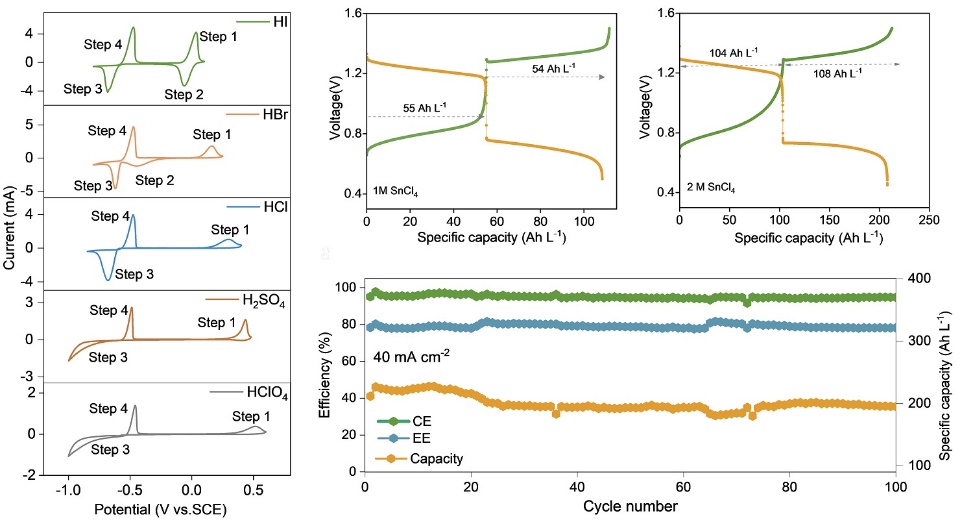
Performance of Sn based flow battery system (Image by XIE Congxin and AO Yue)
To evaluate the strategy in a practical battery system, the researchers paired the highly reversible Sn4+/Sn0 anode with a Br-/Br2 cathode to assemble a Sn-Br flow battery. At the current density of 40 mA cm-2, the battery achieved an energy efficiency of 89%. The anode electrolyte reached a volumetric capacity density of 227 Ah L-1, corresponding to an energy density of 205 Wh L-1.
The researchers further scale-up the technology and validated its operation in a kilowatt-scale stack. The stack operated stably for more than 1,000 hours, demonstrating the potential of this coordination-engineering strategy for the development of high-energy-density flow batteries.