Nitrogen (N2) and methane (CH4) are naturally abundant but extremely inert molecules, making their conversion and utilization highly challenging. Currently, the separate conversion of N2 and CH4 relies on energy-intensive processes, including the Haber-Bosch, steam reforming, and amination processes. Direct co-conversion of N2 and CH4 offers an atom-economical pathway, where CH4 dehydrogenation can directly supplies hydrogen for N2 hydrogenation, thereby bypassing the complex steps. However, simultaneous activation of both molecules and selective construction of N-C and N-H bonds under mild conditions remains a formidable challenge.
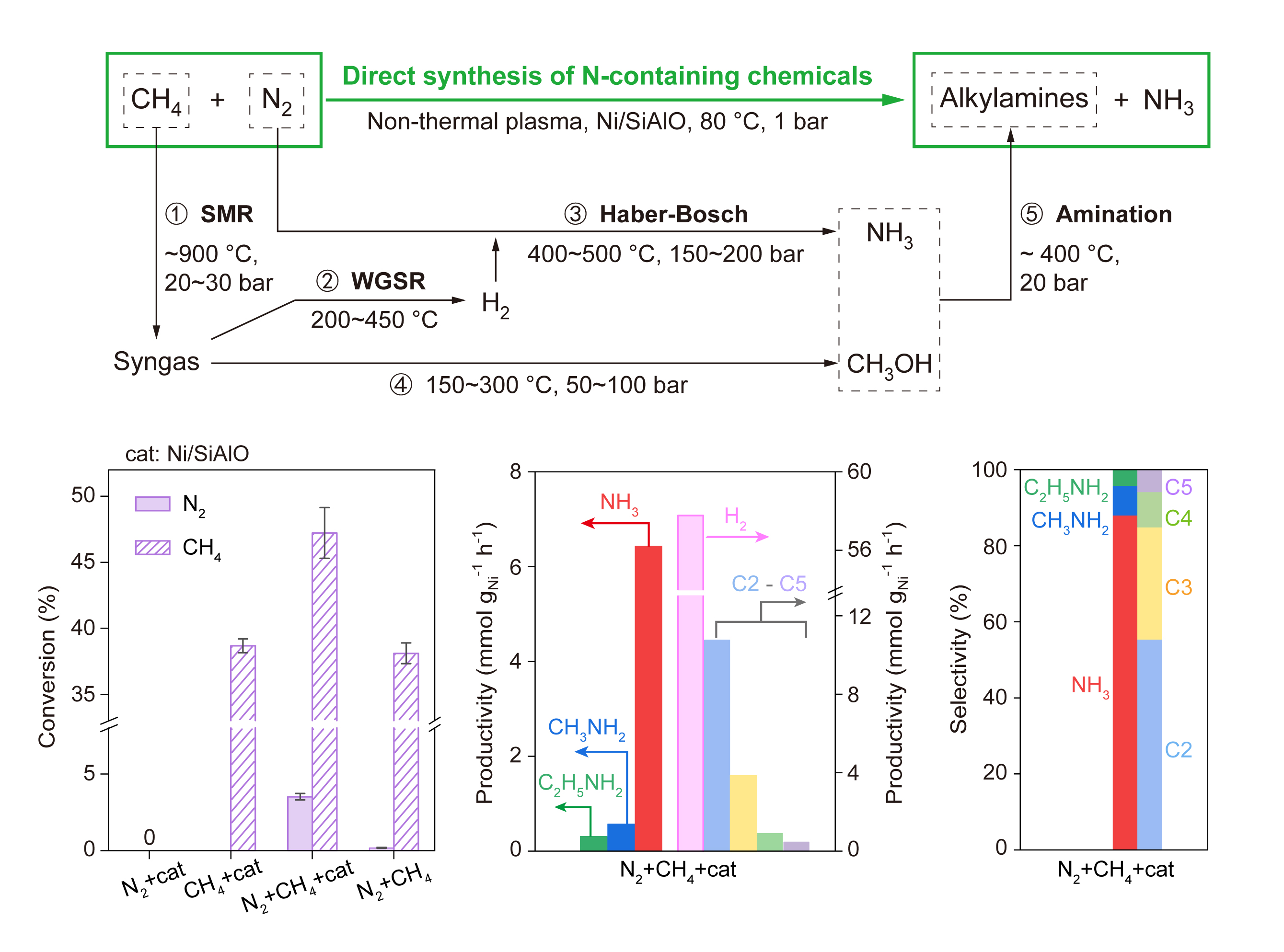
Schematic illustration and the performance for plasma-catalytic conversion of nitrogen and methane to valuable N-containing compounds (Image by LI Di and LIU Ziming)
In a study published in Chem, a research group led by Profs. DENG Dehui and YU Liang from the Dalian Institute of Chemical Physics (DICP) of the Chinese Academy of Sciences (CAS) developed a plamsa-catalysis synergistic process. The process employs SiO2-Al2O3 aerogel-supported Ni nanoparticles (Ni/SiAlO) in a dielectric barrier discharge (DBD) reactor to enable the co-conversion of N2 and CH4 into valuable N-containing compounds under mild conditions
At approximately 80 °C and atmospheric pressure, the process achieved N2 and CH4 conversions of 3.3% and 49.3%, respectively, while co-producing H2 and C2-C5 hydrocarbons. The yields of alkylamines, including methylamine and ethylamine, and ammonia reached 0.88 and 6.43 mmol gNi-1 h-1, respectively.
Through a series of custom-built in-situ characterization techniques and computational studies, the researchers elucidateda significant plasma-catalysis synergy in boosting the co-conversion efficiency. On the one hand, packing the catalyst increases the mean electron energy of the plasma, thereby facilitating the activation of reactants. On the other hand, the adsorption of plasma-derived reactive species on the Ni catalyst promotes the N-C and N-H coupling, enabling the efficient synthesis of alkylamine and ammonia.
"Our study establishes a new route for the direct co-conversion of N2 and CH4 into valuable N-containing chemicals under mild conditions and offers promising prospects for efficient and environmental-friendly chemical synthesis," said Prof. DENG.