The hydration of multinuclear metal hydroxides is ubiquitous in processes ranging from catalytic conversion and metal corrosion to the synthesis and operation of functional materials. During stepwise hydration, the hydrogen-bonding network formed by water molecules can induce reconstruction of the core skeleton and the microscopic coordination environment, thereby driving specific configuration transformations.
Investigating the structural evolution of hydrated multinuclear metal hydroxide clusters is therefore of fundamental significance for understanding the structural characteristics of active sites at authentic solid-liquid catalytic interfaces. However, compared with ionic species, neutral clusters pose greater experimental challenges because they are difficult to detect and mass-select.
In a study published in CCS Chemistry, a research team led by Prof. JIANG Ling and Prof. LI Gang from the Dalian Institute of Chemical Physics (DICP) of the Chinese Academy of Sciences (CAS) experimentally investigated the structural evolution of neutral hydrated binuclear strontium hydroxide clusters, revealing that only three water molecules are sufficient to trigger the configuration transformation of the core skeleton from Sr2(μ2-OH)2(η1-OH) to Sr2(μ2-OH)3. This study provides new insights into the hydration mechanisms of metal-oxygen frameworks in catalysts.
Previously, the team developed a neutral-cluster infrared spectroscopy endstation based on infrared-vacuum ultraviolet (IR-VUV) spectroscopy, integrating infrared (IR) excitation with vacuum ultraviolet (VUV) threshold ionization technology. This platform enables highly sensitive detection, structural characterization, and reactivity studies of mass-selected neutral clusters. By combining the platform with a tabletop vacuum ultraviolet (VUV) light source, the researchers obtained size-selected IR spectra of neutral Sr₂(OH)₃(H₂O)ₙ (n = 1–5) clusters.
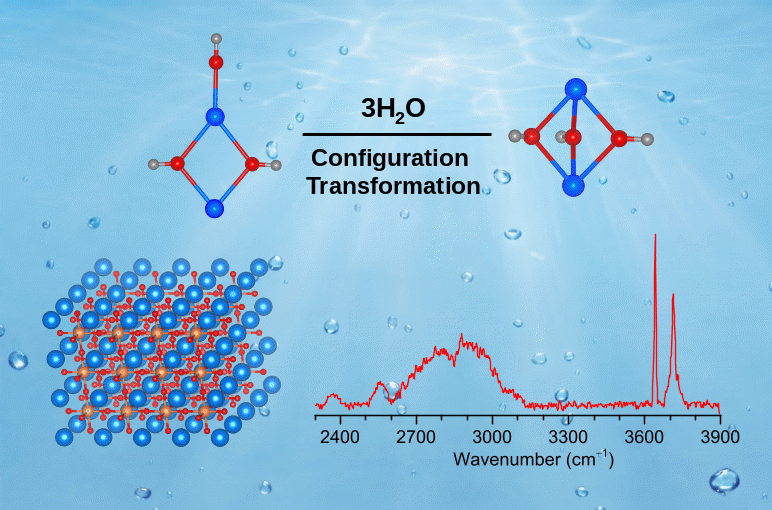
Experimental IR spectra via the 193 nm vacuum ultraviolet laser, identified structures of neutral Sr2(OH)3(H2O)3 clusters, and a Sr-based perovskite model (Image by JIANG Shuai)
Combining the experimental spectra with quantum chemical calculations and ab initio molecular dynamics (AIMD) simulations, the researchers found that clusters with hydration numbers n ≤ 2 adopt the Sr2(μ2-OH)2(η1-OH)(H2O)n configuration, whereas those with n ≥ 3 evolve into the Sr2(μ2-OH)3(H2O)n configuration, revealing a striking configuration transformation occurring at n = 3.This structural transition is driven by pronounced deformation of the Sr2(μ2-OH)2(η1-OH) core skeleton induced by the third water molecule, generating substantial deformation energy.
Through the subsequent rearrangement of the hydrogen-bonding network in the Sr2(μ2-OH)3(H2O)n configuration, the Pauli repulsion energy is effectively reduced, thereby stabilizing the structure and making this configuration the global minimum on the potential energy surface..
The present system serves as an ideal model for depicting metal-oxygen frameworks and hydration processes, providing a new strategy for systematically investigating hydration-driven lattice rearrangement and active-site regulation in catalysts.