A research team led by Profs. CHEN Zhongwei, LUO Dan, and WANG Dongdong from the Dalian Institute of Chemical Physics of the Chinese Academy of Sciences proposed a "polarity-contrast" electrolyte design strategy that effectively enhances the kinetic characteristics and electrochemical stability of lithium metal batteries under extreme low-temperature conditions. The study provides a new electrolyte design paradigm for constructing low-temperature-resistant, anion-dominated solvation structures.
The study was published in Journal of the American Chemical Society.
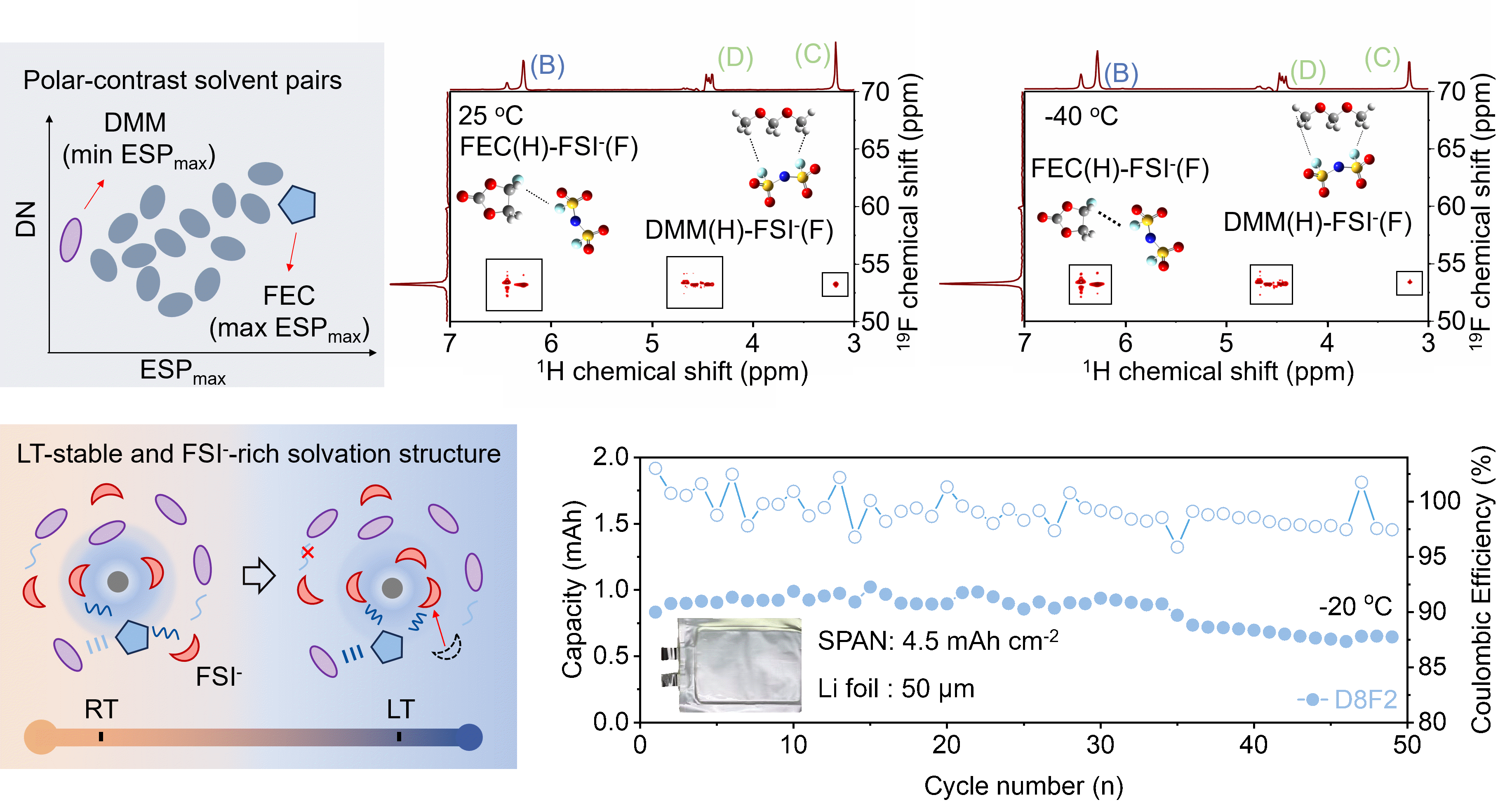
Polarity-contrast electrolyte for low-temperature lithium metal batteries (Image by REN Jingxuan, WANG Dongdong)
Under low-temperature conditions, lithium metal batteries suffer from sluggish ionic transport in electrolytes, retarded Li⁺ desolvation kinetics, and intensified interfacial side reactions. These issues lead to severe capacity degradation and poor cycling stability, thereby hindering their applications in extreme-environment energy storage, electric vehicles, and aerospace fields.
To address these challenges, the team proposed a "polarity-contrast" electrolyte design strategy. This strategy constructs a stable anion-dominated solvation structure at low temperatures by modulating ion-dipole interactions between anions and solvents.
The researchers identified dimethoxymethane (DMM), with the lowest ESPmax, and fluoroethylene carbonate (FEC), with the highest ESPmax, as a polarity-contrast solvent pair. Specifically, the weakened interaction between DMM and FSI- at low temperatures facilitates the entry of anions into the Li⁺ solvation sheath. Meanwhile, FEC further anchors FSI⁻ through enhanced ion-dipole interactions, thereby creating a stable anion-dominated solvation environment under cryogenic conditions.In addition, the strengthened dipole-dipole interactions between DMM and FEC promote Li+ desolvation kinetics.
By precisely tuning ion-dipole and dipole-dipole interactions, the team achieved an anion coordination transition at low temperatures, offering a novel design principle for electrolytes in low-temperature lithium metal batteries.Based on this strategy, the electrolyte induces the formation of a LiF-rich solid electrolyte interphase, enabling uniform lithium deposition and highly reversible plating/stripping behavior at low temperatures.
The Li||SPAN full cell retained 80% of its capacity after 150 cycles at -40 ℃, even at a high areal capacity of 4.5 mAh/cm2. In addition, the Ah-level pouch cell exhibited stable cycling for 50 cycles at -20 ℃, demonstrating good low-temperature cycling stability and capacity retention.
"Our study not only elucidates a novel mechanism underlying the dynamic evolution of solvation structures under low-temperature conditions, but also provides fresh theoretical foundations and research strategies for designing electrolytes for low-temperature lithium metal batteries," said Prof. CHEN.