Extensive research over the past decades has suggested that the original quote of "Life is nothing but an electron looking for a place to rest" by Albert Szent-Györgyi (1937 Nobel Laureate) should be best supplemented by "…with the help of a proton." Indeed, the coupled motion of electron and proton is ubiquitous in both natural and man-made materials, redefining the electronic energy landscape and creating new chemical pathways and material functionalities.
Within this framework, the most famous mechanism is proton-coupled electrontransfer (PCET), which plays an essential role in bioenergetics, cellular respiration, photosynthesis, and nitrogen fixation. It has also inspired the design of many artificialenergy conversion and storage materials. In recent years, a new mechanism termed proton-coupled singlet energy transfer (PCEnT) was also discovered.
Based on prior research on PCET and PCEnT, Prof. WU Kaifeng's team from the Dalian Institute of Chemical Physics of the Chinese Academy of Sciences (CAS), has addressed a missing link in understanding proton-coupled electronic processes, that is, triplet energy transfercoupled with proton transfer. Triplet energy transfer is another important energy transduction mechanism in both natural and man-made materials, and differs fundamentally from singlet energy transfer.
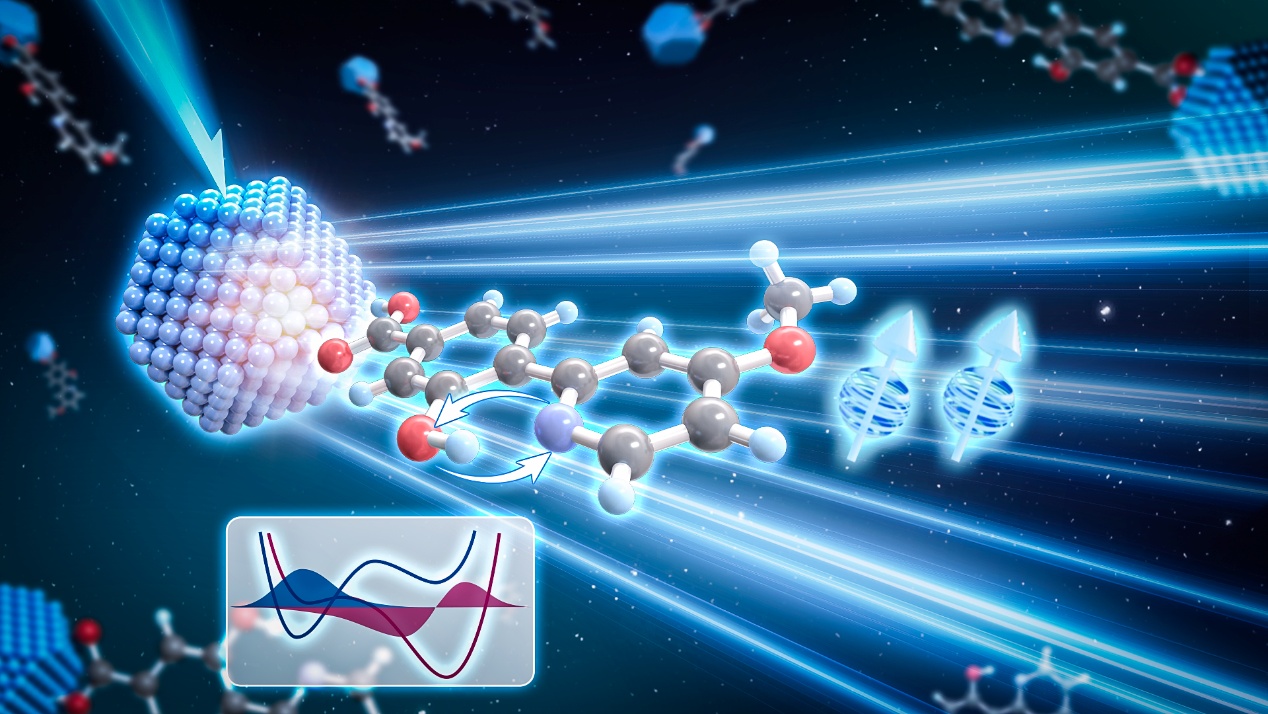
Schematic of proton shuttle-assisted triplet energy transfer (Image by WANG Zhaolong)
In a recent study published in Nature Materials, Prof. WU's team identified a novel mechanism called proton shuttle-assisted triplet energy transfer (PS-TET), which occurs from ZnSe-based colloidal quantum dots (QDs) to their surface-anchoredphenol-pyridine dyadic acceptors.
The researchers found that upon photoexcitation of ZnSe QDs, hole transfer from ZnSe to phenol is coupled with proton transfer from phenol to pyridine. This is followed by electron transfer from ZnSe to the phenoxyl radical, coupled with back proton transfer from pyridinium. These steps complete a net process of spin-triplet migration from ZnSe QDs to the phenol-pyridine dyads.
Although the proton returns to its original position after PS-TET, this proton shuttle has substantially enhanced both the rate and efficiency of triplet energy transfer as compared to a methylated analog lacking the shuttle. The researchers further observed that adding a strongly electron-withdrawing trifluoromethyl substituent on pyridine can switch the sequence of proton-coupled electron and hole transfer steps.
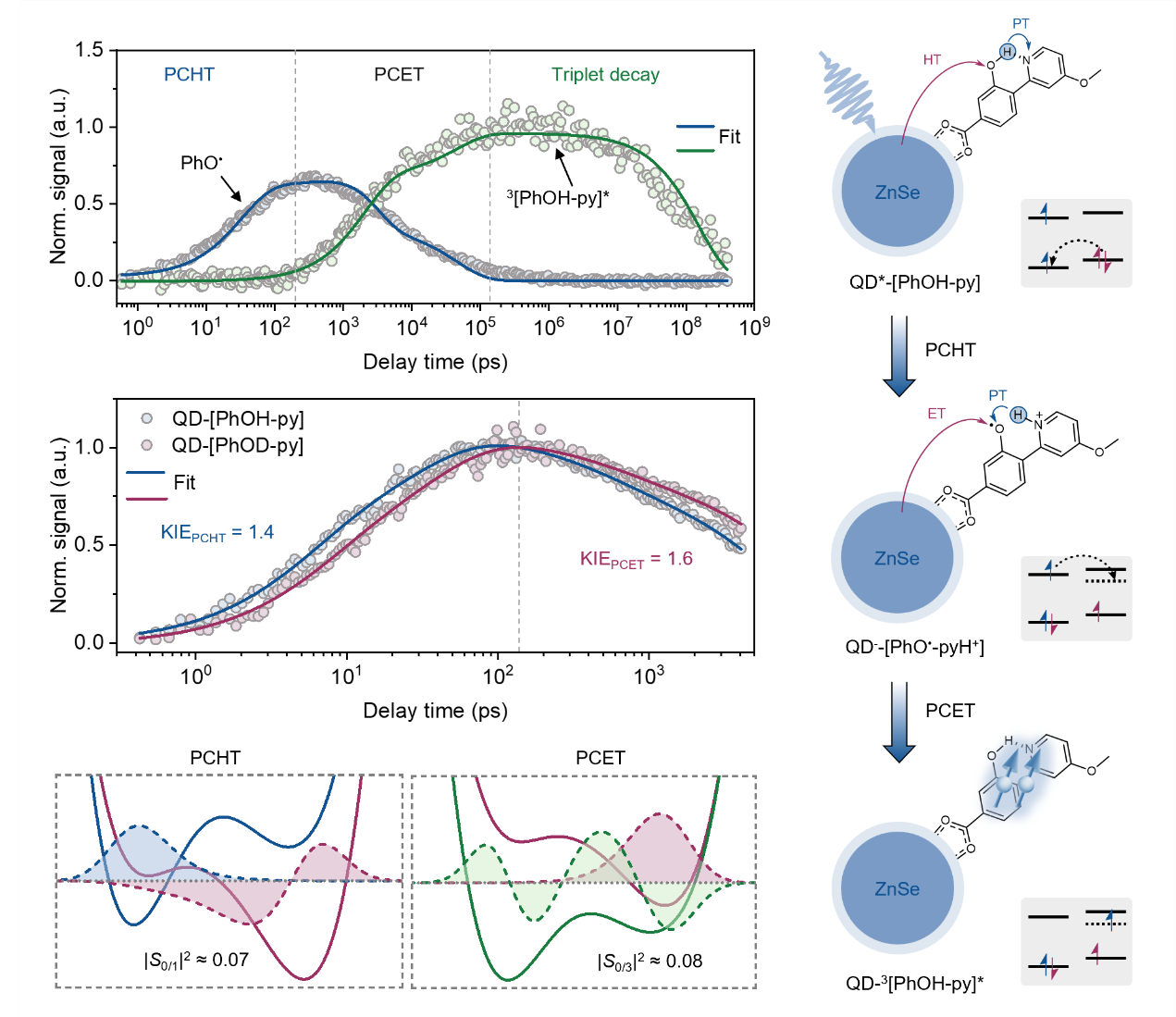
Mechanism of Proton shuttle-assisted triplet energy transfer and the key role of proton tunneling (Image by WANG Zhaolong)
Furthermore, the temperature insensitivity of the rate of PS-TET indicates that the proton shuttle migrates through quantum mechanical tunneling, which is substantiated by calculations of proton vibrational wavefunction overlap integrals. These integrals dictate the excited-state relaxation pathways and guide the system towards efficient triplet energy migration. Thus, this study also demonstrates how quantum effects can be harnessed to control charge and energy transduction in complex materials at room temperature.
"The discovery of the PS-TET mechanism not only represents a landmark in fundamental studies of coupled electron-proton processes, but also has profound implications for many modern molecular technologies involving the spin-triplet excited-states of molecules," said Prof. WU. For example, enhancing triplet generationefficiency benefits photoredox and environmental catalysis, while organic optoelectronic devices such as solar cells and lasers require suppression of triplet formation.
This study suggests that creation or elimination of a proton shuttle can enable on-demand enhancement or suppression, respectively, of triplet formation.