Perovskite materials are regarded as promising candidates for next-generation solar cells owing to their excellent optoelectronic properties. However, during the fabrication of perovskite polycrystalline films, defect formation, lattice mismatch, and energy-level misalignment often arise at the buried interface, which increase non-radiative recombination and accelerate photothermal degradation, limiting the efficiency and long-term stability of perovskite solar cells.
In a study published in Advanced Materials, a research team led by Prof. YANG Dong from the Dalian Institute of Chemical Physics(DICP) of the Chinese Academy of Sciences (CAS), in collaboration with Prof. WU Congcong's team from Hubei University, proposed a novel strategy to regulate the buried interface through multifunctional molecular bridges, enabling efficient defect passivation and improved energy-level alignment.
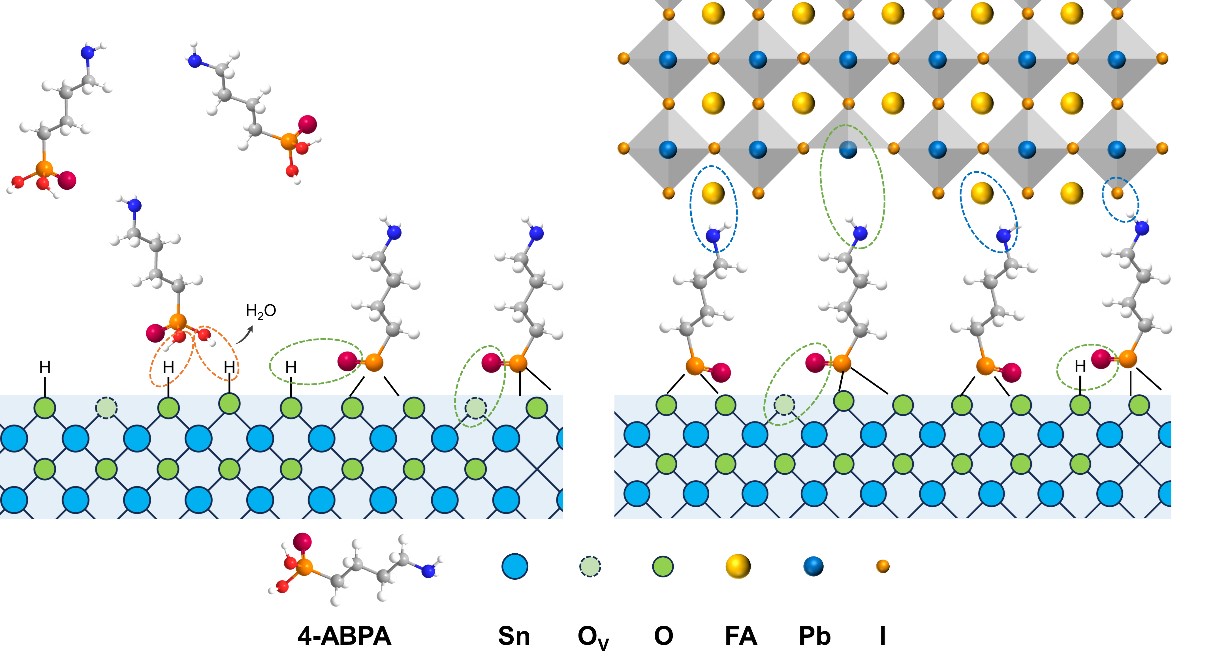
Schematic illustration of 4-ABPA interactions at the buried interface (Image by ZHOU Zezhu)
The researchers employed 4-aminobutylphosphonic acid (4-ABPA) to modify the interface between the SnO2 electron transport layer and the perovskite layer. The phosphonic acid group anchored onto the SnO2 surface via covalent P-O-Sn bonding, while the amino group coordinated with Pb2+ and I- ions in the perovskite lattice, forming a stable molecular bridge. This molecular interlayer provided heterogeneous nucleation sites, facilitated phase transformation, reduced interfacial pinholes, improved crystal orientation and crystallinity, and alleviated residual stress in the perovskite film.
Moreover, the researchers found that 4-ABPA modification enhanced photoluminescence intensity and carrier lifetime while optimizing energy-level alignment between the electron transport layer and the perovskite layer. The voltage loss was reduced to 31 mV, enabling power conversion efficiencies of 25.56% in n-i-p devices with negligible hysteresis and 26.45% in p-i-n architectures. The modified devices showed good long-term stability, retaining 83.91% of their initial performance after 1,440 hours of continuous operation and 91.59% after 2,600 hours of storage under ambient conditions.
"We develop a systematic buried-interface engineering strategy that improves both efficiency and stability, offering new insights for the scalable development of perovskite solar cells," said Prof. YANG.