Ceramic films are widely used in solid-state batteries, energy conversion devices, and electronic systems. However, their fabrication often requires high-temperature sintering, which can lead to element volatilization, compositional segregation, and undesirable interfacial reactions. Achieving dense, compositionally uniform ceramic films at lower temperatures therefore remains a challenge.
Recently, a research team led by Profs. YANG Weishen and ZHU Xuefeng from the Dalian Institute of Chemical Physics (DICP) of the Chinese Academy of Sciences (CAS) has developed a liquid-phase growth (LPG) strategy to densify ceramic films at substantially lower temperatures.
The study was published in Nature Synthesis on Oct. 29.
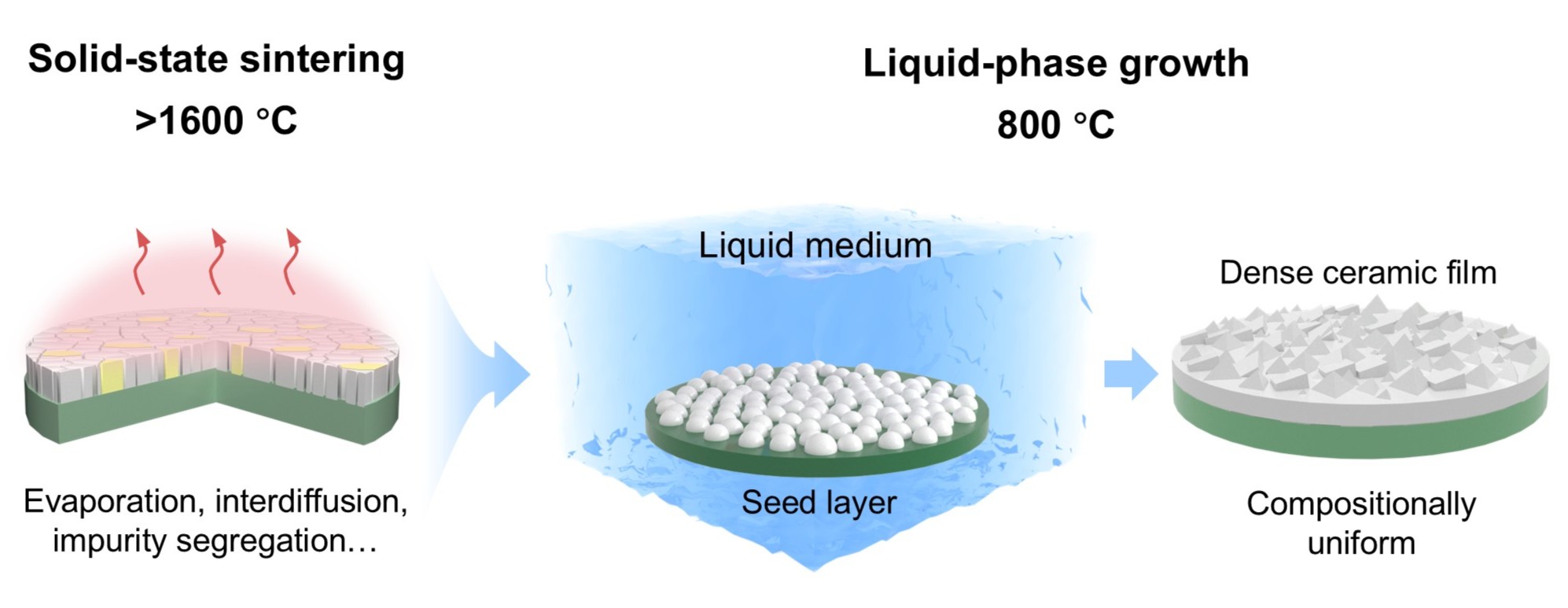
Comparison of solid-state sintering and liquid-phase growth for ceramic film fabrication. (Image by ZHU Xuefeng and FENG Qiuxia)
The researchers selected yttrium-doped barium zirconate (BZY), a proton-conducting ceramic with a melting point of approximately 2,700 °C, as a model material. They used molten carbonates as the liquid growth medium and introduced a seed layer to guide crystal nucleation and growth. This approach enabled them to fabricate dense BZY electrolyte films approximately 10 μm thick at 800 °C under ambient pressure. The resulting films exhibited uniform composition, with limited secondary-phase formation and interfacial elemental interdiffusion.
In addition, the researchers used in situ characterization to track the growth process, from molten salt formation and precursor dissolution to crystal nucleation and growth. Fuel-cell tests confirmed the favorable electrochemical performance of the resulting films. The researchers also demonstrated the applicability of this strategy to large-area fabrication, metal substrates, and other ceramic materials, pointing to its potential for versatile low-temperature ceramic manufacturing.
"Conventional ceramic processing often relies on high temperatures, which can compromise material composition and interface quality," said Prof. ZHU. "Our liquid-phase growth strategy offers an alternative route to fabricating dense ceramic films at lower temperatures. It could also be adapted to different ceramic materials and substrates, opening up new possibilities for their processing and application."