Slot-die coating is a promising route for the industrial production of perovskite solar cells because of its high material utilization and compatibility with continuous roll-to-roll processing. However, fabricating high-quality perovskite films in ambient air remains challenging, particularly because of the narrow processing window and difficulties in achieving uniform film formation.
In a recent studypublished in Advanced Materials, researchers have developed a synergistic additive strategy to address these challenges in the large-area slot-die coating of methylammonium-free (MA-free) perovskite films. The approach improves both the efficiency and operational stability of perovskite solar cells.
The study was conducted by a collaborative team led by Prof. YANG Dong from the Dalian Institute of Chemical Physics (DICP) of the Chinese Academy of Sciences (CAS) and Prof. ZHANG Zhihua from Dalian Jiaotong University.
The MA-free FAxCs1-xPbI3 perovskite system offers good potential for stable device operation because it avoids the use of volatile methylammonium component. However, it also presents challenges for film fabrication. Its intrinsically slower crystallization kinetics and greater tendency toward phase segregation make it more difficult to control wet-film formation and achieve uniform crystallization during ambient-air coating. These factors can also compromise phase stability in the resulting films.
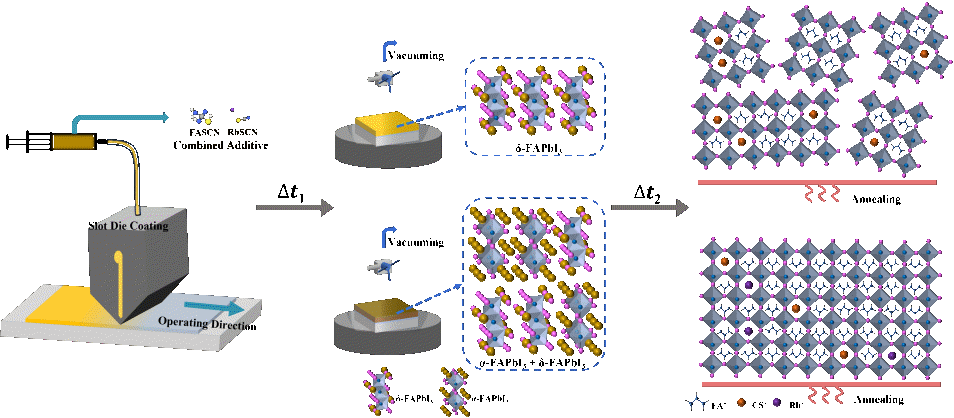
Schematic diagram of slot-die coating and Δt constituents. (Image by DUAN Lianjie)
To overcome these challenges, the team developed a synergistic additive strategy using formamidinium thiocyanate (FASCN) and rubidium thiocyanate (RbSCN). The two additives play complementary roles: FASCN promotes nucleation induced by vacuum flash treatment and subsequent crystal growth, while RbSCN helps stabilize the photoactive perovskite phase. Specifically, Rb+ occupies the A site of the perovskite lattice, relaxing lattice strain and lowering the activation energy for the formation of the photoactive α-FAPbI3 phase. This helps suppress the formation of the non-photoactive δ-FAPbI3 phase.
With these complementary effects, the team extended the processing window for uniform perovskite crystallization to more than 100 seconds. The resulting films feature dense structures, large-grains, a uniform vertical compositional gradient, and reduced residual stress.
The resulting small-area perovskite solar cells achieved a power conversion efficiency (PCE) of 26.16%. A large-area module with an active area of 54.80 cm2 achieved a PCE of 22.70%, substantially higher than the 15.8% achieved by the control module.
The strategy also improved operational stability. Unencapsulated devices retained 97.76% of their initial efficiency after 1,300 hours of continuous maximum power point tracking under AM 1.5G illumination at 65 °C. By comparison, control devices retained only 65.86% of their initial efficiency under the same conditions.