Recently, a research team led by Prof. XU Guowang and Prof. LIU Xinyu from the Dalian Institute of Chemical Physics (DICP) of the Chinese Academy of Sciences (CAS), in collaboration with Prof. ZHAO Zongbao's team at Dalian University of Technology, has developed a high-coverage lipidomics workflow and integrated it with transcriptomics to investigate lipid accumulation and compositional changes in Rhodosporidium toruloides under nitrogen limitation.
The study was published in Food Chemistry on October 14.
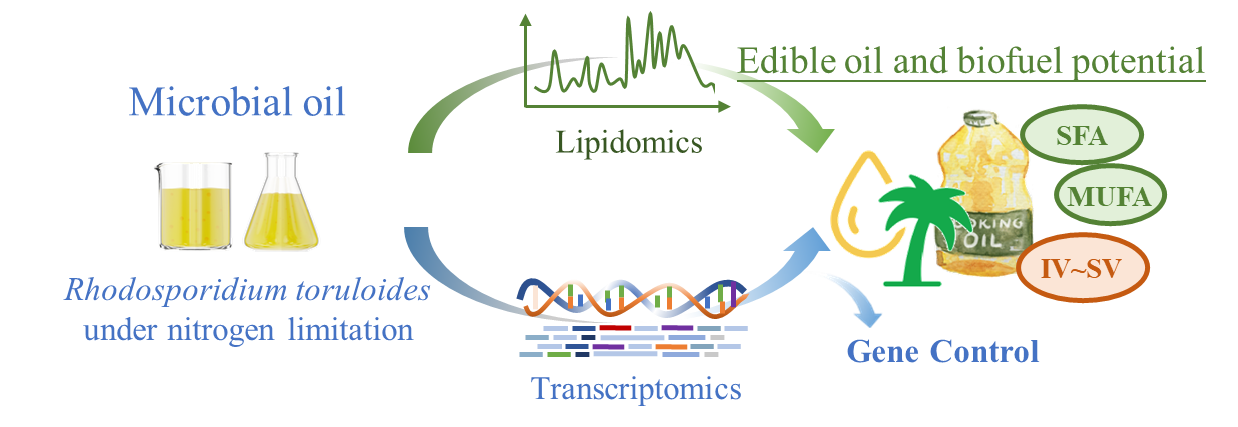
Integrated lipidomics and transcriptomics reveal changes in microbial oil accumulation and composition under nitrogen limitation. (Image by YU Di)
Microbial oils are promising sustainable lipid sources for food and biofuel applications. Although R. toruloides can accumulate substantial amounts of oil, previous studies have mainly focused on total lipid production and overall fatty acid composition. Changes in individual lipid species across cultivation stages have remained less well characterized.
To address this gap, the team established a liquid chromatography-mass spectrometry-based lipidomics workflow that combines quantitative structure–retention relationship modeling with complementary mass-spectral database matching. This approach enabled the identification and quantification of 1,206 lipid species across 26 subclasses, providing detailed coverage of both storage and structural lipids.
Using this workflow, the researchers identified two stages of lipid production under nitrogen limitation. They found that triacylglycerols (TAGs) accumulated rapidly, reaching a peak at 144 hours. During subsequent cultivation, major TAG and diacylglycerol species declined, while polyunsaturated lipids became relatively enriched. Compared with common edible oils, microbial oil produced between 48 and 168 hours showed some compositional similarities to palm oil. At 216 hours, the oil contained a higher proportion of polyunsaturated fatty acids, indicating a different fatty acid profile with potential nutritional relevance. These findings suggest that cultivation time could help tailor both oil yield and composition.
Transcriptomic analysis further identified partially distinct metabolic modules associated with lipid accumulation and compositional remodeling. Together, these results provide a basis for evaluating microbial oil composition and exploring tailored production strategies.